
Aphrodite: Meaning, Symbols & the Goddess of Love
No figure in Greek myth has been depicted more often, or desired more openly, than Aphrodite — goddess of love, beauty, desire and pleasure. She was said to have been born from the sea itself, rising fully formed from the foam, so lovely that the seasons rushed to clothe her. Wherever she walked, flowers opened underfoot.
To the Greeks she was not only romance but attraction in every sense: the pull between people, the charm of a face, the quiet power of beauty to move the world. The Romans called her Venus, and under both names she has never left our art, our language, or our jewellery.
Born from the sea
The birth of Aphrodite
The oldest myth is also the strangest. When the Titan Cronus overthrew his father Uranus and cast his remains into the sea, the waves churned into white foam — aphros in Greek — and from it Aphrodite emerged, carried ashore on a scallop shell at Cyprus. It is the scene Botticelli would paint two thousand years later in The Birth of Venus: beauty arriving from the water, timeless and self-created.
“From the foam of the sea, beauty came ashore — and never left.”
Her language of symbols
How to read Aphrodite
Aphrodite rarely appears alone. She travels with a constellation of symbols, each a shorthand for a different face of love:
Symbols of Aphrodite
Together they map the whole territory of love — from first attraction to lifelong devotion — which is why the goddess has always been a favourite subject for pieces given between lovers.
Twenty-five centuries of beauty
Aphrodite in art

No deity has inspired more masterpieces. The Venus de Milo, carved around 100 BCE and now in the Louvre, remains the most famous sculpture of the ancient world. Botticelli, Titian, and Cabanel each painted her birth; the Romans filled their gardens with her likeness. Her appeal endures because she stands for something everyone recognises — the moment beauty becomes irresistible.
Sculpted by Kelyoz
Our interpretation

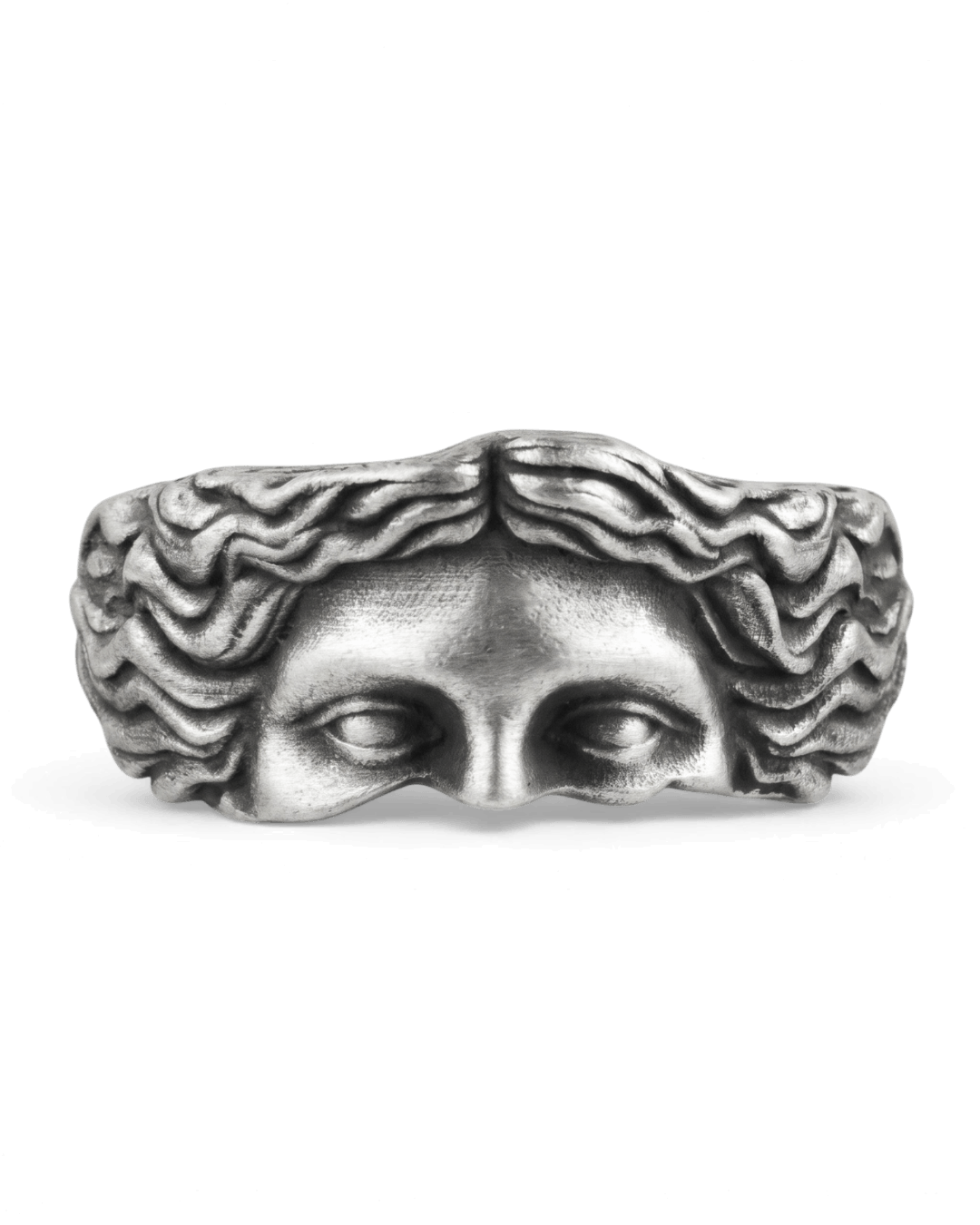
We didn’t print a picture of Aphrodite onto metal — we sculpted her. The face on the Aphrodite ring is modelled in true three-dimensional relief, the way a cameo is carved, so the light moves across her brow, her hair and the curve of her cheek as your hand does. It is cast in premium, water-resistant stainless steel that holds that depth for years, not months.
That is the idea behind every Kelyoz piece: a myth you don’t just read about, but carry — a small piece of wearable sculpture.
The myth, worn
Wearing Aphrodite today
To wear Aphrodite is to carry a small emblem of love and self-assurance — not vanity, but the ancient belief that beauty is a kind of power. Given between lovers or worn as a quiet statement of one’s own, it does what the goddess always did best: it draws the eye, and holds it.